13 JAN 2026 (TUE) 15:00-16:00
Updated: Jun 2
Geography Distinguished Seminars Series
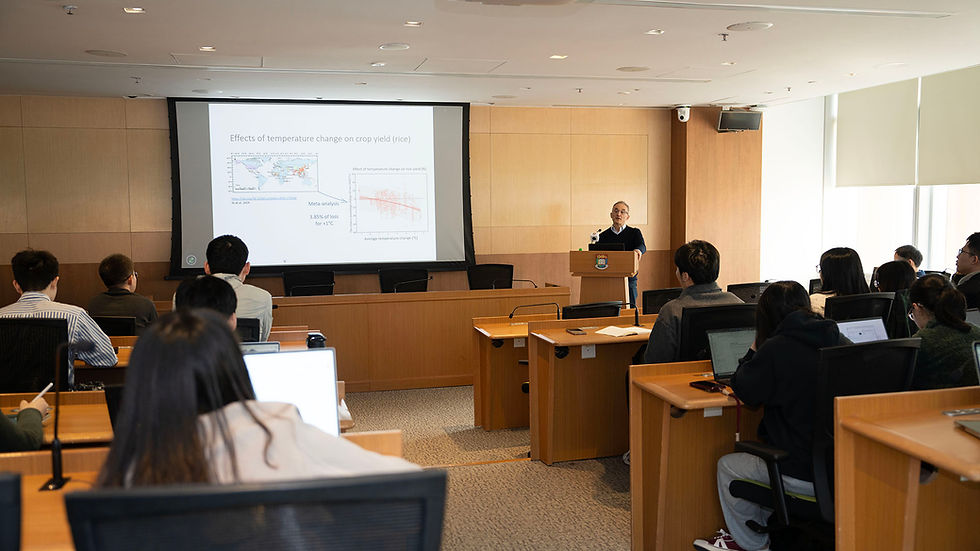
How to adapt farming systems to climate change
Date: 13 JAN 2026 (Tuesday)
Time: 15:00-16:00 (HKT)
Venue: Chamber, Faculty of Social Sciences, 11/F, The Jockey Club Tower, Centennial Campus, HKU
Mode: Hybrid
Via Zoom: Zoom link will be provided upon successful registration
Registration link: https://hkuems1.hku.hk/hkuems/ec_hdetail.aspx?guest=Y&ueid=104699
Abstract:
Climate change impacts agricultural production in a multitude of ways. Rising temperatures, changes in precipitation, and evapotranspiration not only affect plant development and growth, but also crop diseases and pests. The consequences affect yields and the quality of certain agricultural products, particularly major cereals such as rice, and also the cropping areas and prices of agricultural commodities and food products. In this presentation, I will review the different approaches considered by international research groups to assess the impact of climate change on agriculture, in particular experimental approaches and simulation models. I will then present the various adaptation strategies currently being promoted to reduce the negative impact of climate change, specifically; crop migration, crop substitution, plant breeding, change in sowing and harvest dates, irrigation, change of cropping systems. Finally, I will present some recent findings evaluating the effectiveness of these adaptation strategies.
Professor David Makowski
Professor, Université Paris-Saclay and Research Director at INRAE
David Makowski is a Research Director at INRAE specializing in statistical and mathematical modeling for agriculture and the environment. His work focuses on meta-analysis, uncertainty quantification, and risk assessment applied to crop yields, pest and disease dynamics, fertilizer use, and greenhouse gas emissions. He develops and calibrates predictive models to support decision-making under uncertainty and contributes to national and European expert panels on agri-environmental risks.