Professor Kuishuang Feng's Team Publishes in Nature
Updated: Aug 19
Sustainability, Revealing Consumption Inequality Threatens Resource Sustainability
Recently, Professor Kuishuang Feng from the Department of Geography at The University of Hong Kong, in collaboration with multiple domestic and international research teams, has made significant progress in the field of sustainable consumption research. The related findings have been published online in Nature Sustainability under the title "Consumption inequalities in material use undermining resources sustainability."
Furthermore, Nature Sustainability has specially invited Professor Feng's team to contribute a policy brief titled "Levers for equitable material use," which further elaborates on the application value of their research findings for sustainable policy-making.
Links for full articles
Consumption inequalities in material use undermining resources sustainability
Levers for equitable material use


Growing global resource consumption is pushing the Earth system beyond its ecological limits. How to achieve sustainable resource use is a critical frontier issue in sustainability policy research. However, current global sustainability policies primarily focus on improving production efficiency at the national level, with little attention paid to the distribution of resources on the consumption side: namely, the stark contradiction between the resource-intensive lifestyles of affluent groups and the unmet basic material needs of impoverished populations, which threatens both ecological security and social equity.
The research team developed a multi-scale assessment framework integrating micro-consumption survey data and macro-economic accounting. By combining household expenditure survey data covering 168 countries and 98% of the global population with an environmentally extended multi-regional input-output model, they systematically quantified the global material footprint on the consumption side for 2017 (covering four resource categories: biomass, fossil fuels, metals, and non-metallic minerals). Using methods such as the Gini coefficient, allocation of overshoot responsibility, and consumption elasticity analysis, the study explored how consumption-side inequality affects resource sustainability across global, regional, national, and consumption category dimensions.
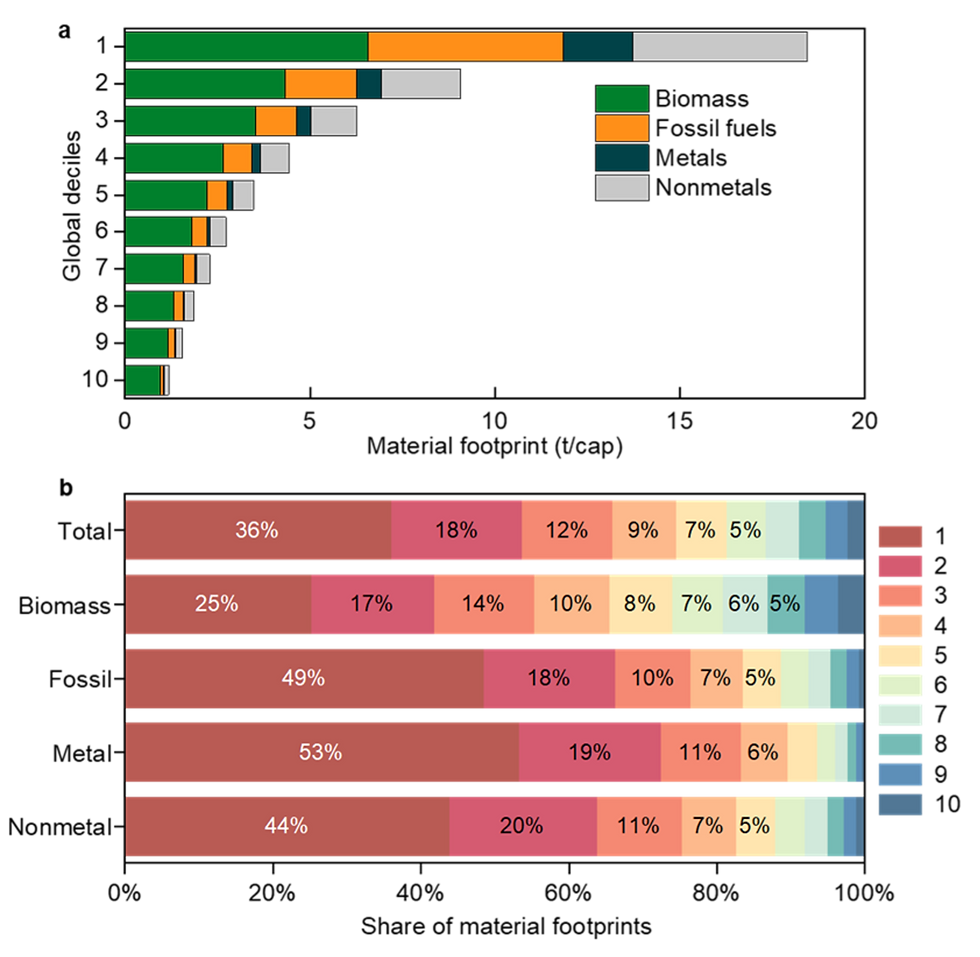
The findings reveal that the top 10% of global consumers account for 36% of total global resource consumption, while the bottom 50% account for only 18%. This inequality is particularly pronounced for non-renewable resources such as metals and fossil fuels: the top 10% consume 53% of global metals and 49% of fossil fuels. Their per capita resource consumption is 15.6 times that of the bottom 10% (and as high as 113 times for metals). Elasticity analysis indicates a "re-coupling" phenomenon between resource consumption and expenditure at higher consumption levels. Particularly for metals, consumption increases almost proportionally with spending, suggesting that relying solely on technological efficiency and decoupling from economic growth is insufficient for achieving absolute reductions in resource use.
This study is the first to systematically uncover, at a global scale, the profound inequality in resource consumption across different groups and their differentiated responsibility for planetary overshoot. It provides crucial empirical evidence for understanding and addressing the global resource crisis. The research clearly indicates that current sustainability strategies focused primarily on enhancing production efficiency and controlling aggregate volumes will fail to achieve genuine Earth system security if they do not effectively address the inequality challenge. These findings offer key scientific groundwork for promoting equitable and effective global resource sustainability policies.