Professor Kuishuang Feng's Team Publishes in Nature
Updated: Aug 19
Climate Change, Revealing the distributional effects of expanding climate targets beyond CO₂
Recently, Professor Kuishuang Feng from the Department of Geography at The University of Hong Kong, in collaboration with multiple domestic and international research teams, has made significant progress in the field of climate change mitigation policies and social justice. The related findings have been published online in Nature Climate Change under the title " Distributional effects of expanding climate targets beyond CO₂" .

Integrating non-CO₂ greenhouse gases into coordinated climate control represents a new trend in global climate governance. Methane, nitrous oxide, and fluorinated gases are characterized by "low concentration and high warming potential," and their emission reduction pathways typically have lower marginal costs, making their inclusion in mitigation strategies highly cost-effective. However, policies aimed at reducing emissions can increase production costs, which may be transmitted through supply chains to consumers, causing product price fluctuations and resulting in differential impacts on various consumer groups. Existing research shows that carbon pricing often disproportionately burdens low-income populations, but little attention has been paid to the distributional issues related to expanding climate targets to non-CO₂ greenhouse gases. Ignoring such consumption-side inequalities can directly affect public support and the implementation effectiveness of global climate policies.
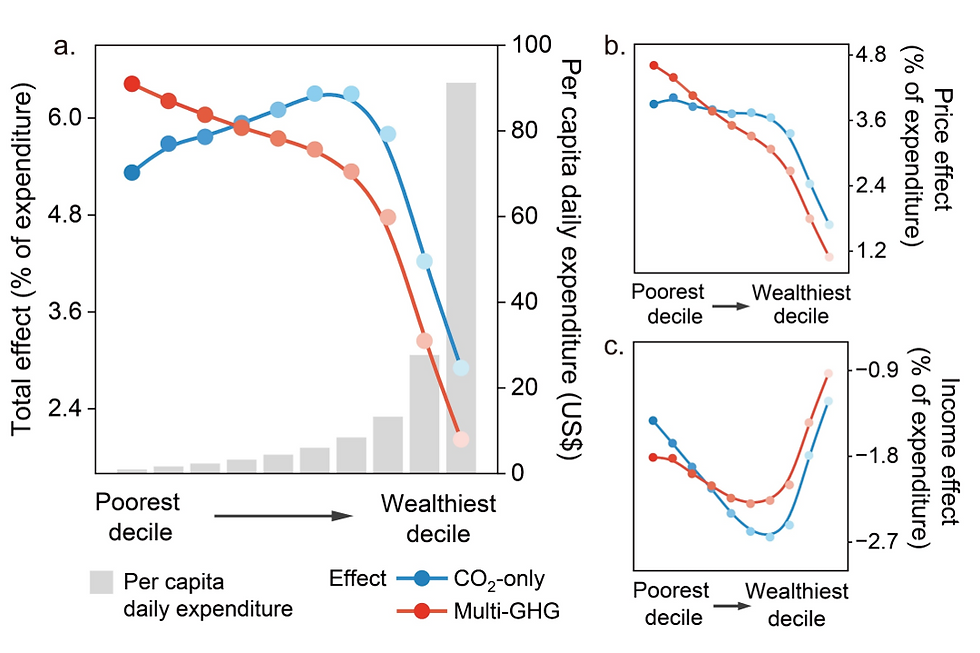
The research team combined global household expenditure and income survey data with a multi-regional input-output-based global social accounting matrix model to systematically quantify the distributional effects of two pricing policies under the same Paris Agreement climate goal—one pricing only CO₂, and the other covering both CO₂ and non-CO₂ greenhouse gases. By tracking price and income effects through global supply chains, the study explored the impacts of these policies on household living costs and consumption budgets across multiple dimensions, including globally, regionally, nationally, and by consumption category.
The findings indicate that, compared to policies that only price CO₂, incorporating non-CO₂ greenhouse gases into multi-gas pricing significantly increases regressivity, leading to a higher relative burden on poor households and a reduced burden on wealthy households. This structural shift in household burdens is mainly influenced by differences in consumption patterns and income structures. While multi-gas pricing tends to lower energy prices, it also raises prices for food and water. Since poor households allocate a larger share of their expenditures to food, the rise in food prices hits them harder, especially as their income from labor decreases, increasing their economic burden. Conversely, wealthier households benefit more from falling energy and transportation fuel prices, with their primary capital income losses being less affected. Regionally, including non-CO₂ gases generally alleviates the burden on households in high-income countries such as Europe and North America but significantly increases costs for households in low-income regions like Sub-Saharan Africa and Latin America, effectively shifting the burden of emission reductions from middle-income countries to the world's poorest areas.
This study systematically reveals the social inequality risks associated with the transition to climate goals at a global scale, providing critical scientific evidence for fair global climate mitigation policies. It highlights that to ensure the social acceptability of climate governance, policy design must incorporate fairness considerations. The study recommends that, when expanding climate targets to include non-CO₂ gases, governments should simultaneously implement targeted interventions such as agricultural subsidies, direct financial support, and food aid to alleviate the economic burdens on vulnerable groups, thereby achieving just and equitable global greenhouse gas reductions while maintaining social fairness.

Links for full articles
Distributional effects of expanding climate targets beyond CO2