Professor Kuishuang Feng’s recent paper in Nature
Towards an equitable future of global photovoltaic waste recycling
The world’s rapid push for solar energy is creating a mounting waste crisis that could see nearly 400 million tonnes of retired photovoltaic panels accumulate by 2060, according to a new study published in Nature. This study provides a comprehensive global assessment of photovoltaic waste generation and recycling strategies.

Solar photovoltaics have become the fastest‑growing source of clean energy worldwide, but early installations are now entering mass retirement. These end‑of‑life modules contain valuable strategic materials, such as silicon, silver, copper, and aluminium, and also harbour toxic substances such as lead and fluorine. Improper disposal risks permanent soil and groundwater contamination, while lost material value threatens the solar industry’s long-term sustainability. However, recycling capacity and policies remain deeply uneven across regions, making a one‑size‑fits‑all approach ineffective.
To address this challenge, the study developed an integrated modelling framework that couples material price projections with the Global Change Analysis Model, dynamic material flow analysis, life‑cycle assessment, and life‑cycle cost analysis. They evaluated 1,708 distinct scenarios spanning different decommissioning pathways, recycling technologies, international trade configurations, and subsidy designs across 32 global regions.
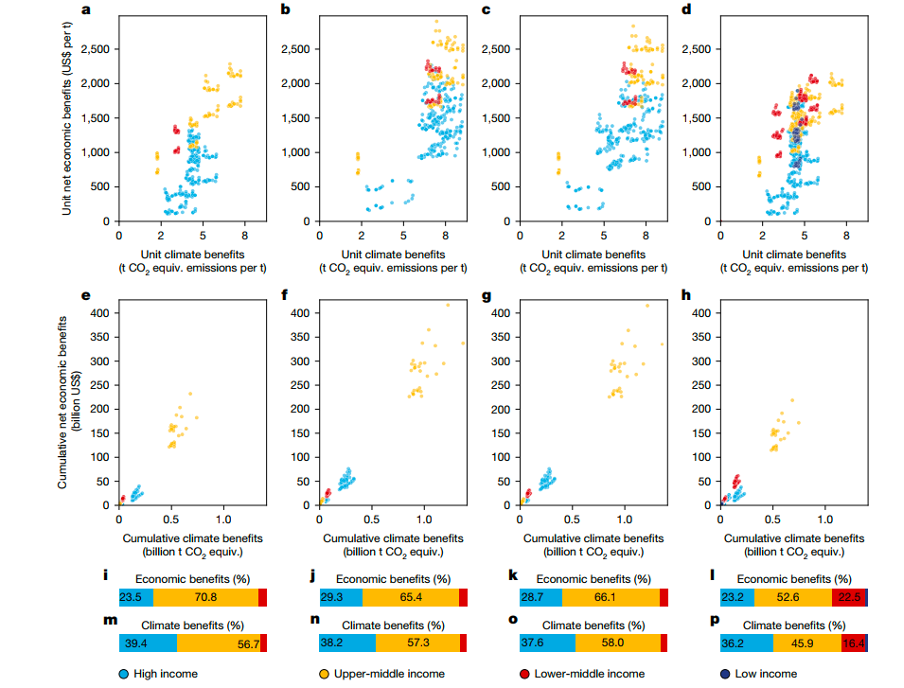
The study reveals a dramatic geographic shift in PV waste. Until 2040, high-income regions dominate the waste stream; by 2060, the epicentre moves decisively to emerging economies, with China alone accounting for 36%–40% of the global total, far surpassing Europe and the United States. Supply-side constraints could delay deployment by up to 8.4%, equivalent to a five-year setback for climate targets. Recycling is unlikely to break even before 2035–2040, but by 2060 cumulative net benefits could reach US$529–935 billion, with avoided emissions of 2.2-3.3 Gt CO₂ — over 67% higher than business-as-usual.
However, a sharp trade‑off emerges between efficiency and equity. When waste can move freely across borders, it tends to flow towards regions with more advanced recycling technologies and lower costs, increasing overall economic returns. Under an extended producer‑responsibility regime, global benefits are maximised, but they concentrate overwhelmingly in upper‑middle‑income economies, which capture roughly three‑quarters of all net economic gains. Low‑income regions receive negligible shares. Expanded global trade and regional trade scenarios distribute benefits more evenly but reduce total returns, as waste is diverted to regions with weaker learning effects and higher costs.
To mitigate these inequalities, the study tested five subsidy designs. A declining‑subsidy scheme, which phases out fiscal support as recycling becomes self‑sustaining, proves the most cost‑effective. It requires only 3%–12% of the spending required for a continuous subsidy while achieving slightly greater improvements in equity. In contrast, high carbon‑price subsidies can worsen global disparities by disproportionately favouring regions with mature carbon markets and advanced recycling infrastructure, widening the unit‑benefit gap between regions.
“Achieving a circular photovoltaic economy is not just a technical challenge – it is fundamentally a geographical and equity challenge,” Professor Feng said. “Our results show that we can capture enormous climate and economic value, but we need carefully designed policies, technology transfer, and international funding to ensure that the benefits reach all regions, not just the wealthiest.”
The findings suggest that recycling strategies will need to reflect regional differences in technology, infrastructure and financing. Wealthier economies may be better positioned to invest in advanced recycling capable of recovering high-purity materials, while lower-income countries may require more basic recycling infrastructure, technology transfer and international financial support.
The study also highlight module reuse and refurbishment as complementary transitional strategies, particularly for regions lacking infrastructure, though they note that performance heterogeneity and market confidence remain barriers to large‑scale adoption.
The study, “Towards an equitable future of global photovoltaic waste recycling,” was published in Nature on 12 August 2026.